This photo is a mosaic of two I took during the English Raid (can you spot the join?), looking down on Daisy G at low tide from the quayside at Keyhaven. I think is gives a very good view of the Baycruiser form. They are really quite beamy, although quite narrow at the waterline. This is partly why they have such high form stability. As soon as she starts to heel, a great chunk of the overhanging side is forced into the water and this in turn pushes buoyantly back. She is very stable even without the water ballast, but rock solid with it.
This photo, taken from the same quayside, shows a comparison between the original Bayraider (Simon Knight's fibreglass Carpe Diem in this case) and the Baycruiser. They really are quite different. The surrounding bulwark on the BC gives a really nicely enclosed foredeck. There is also no under-sidedeck stowage on the Bayraider, which is so useful on the Baycruiser (see the previous post to see the boathooks stored in this area). On the other hand, it has bigger under bench cockpit lockers on both sides plus a huge storage area under the foredeck. The original proposed cabin verison of the Bayraider was to have just a slightly raised and extended foredeck to form a "camping cuddy". I think there are still plans to pursue this. I wanted a full cabin to use as my Wendy house, as my wife describes it. Simon and I are convinced the Baycruiser is significantly longer than the Bayraider, more than the specified 5 inches, but we never got round to actually measuring them.
This angle also clearly shows the original and revised positions of the jib sheet fairlead tracks. The originals, on the cabin roof, were too close to the centreline, despite Matt insisting that they met all the theoretical design requirements. The new positions on the grab rails are a bit odd looking but work well. I am going to remove the original tracks over the winter.
Just to complete the comparison. This view gives an idea of the different cockpits of the Raider and Cruiser. The under side deck stowage shows up clearly. You can also see my stern ladder in its "deployed" position and the tiller control line, which hooks over a cleat on the under side. Knots in the line stop the tiller slipping and bungees at each end make it easy to whip on and off.
Just to complete the picture, this is the design that started it all, a Searaider, Pelham Olive's Lattis, tied up alongside Daisy G at Buckler's Hard. This is a racing boat with twin headsails on a permanent bowsprit, all sorts of adjustment tackles and a tiller controlled by tiller lines aorund the engine well. They even had trapeze wires. But... they had to sleep on board the Thames barge mother ship, whilst my daughter and I slept comfortably aboard Daisy Grace for five nights. Horses, or boats, for courses.
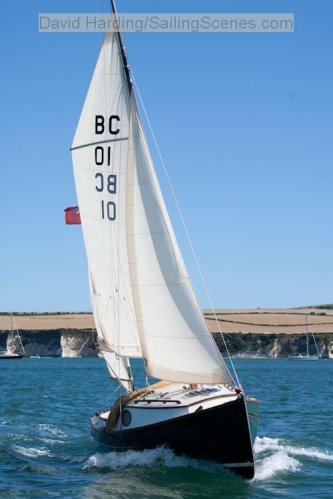
And finally (is there ever a finally) the one they are all talking about, the Bayraider 17, under sail and under tow. This is Matt Newland's own boat. I think it is a stunner. It is so sleek and simple inside. I see this as a big seller and a real replacement to the Drascombe Dabber, which was always my favourite.
The shed builder arrived on site this morning and started sawing bits of wood! Yay!
13 December 2010
12 December 2010
New bulkhead going in
The weather has eased up at last and I could do a few jobs over the weekend. I have finished the main part of the new internal bulkhead and fixed it in place. It is held between hardwood strips glued to the cabin wall and ceiling, which should mean that it can be removed if it is a bad idea. But that will involve breaking the panel, it can't go in or come out as a single piece. I still have to fit a filling panel between the new bulkhead and the sloping compression post. That is made up and is curing in the utility room. So far I am happy with the result, but it is hard to judge until all the cushions and general cabin detritus is in place.
I have fitted two screwed and glued blocks under a cockpit side deck which support two staineless steel hooks each. These are to hold the boat hooks so that they don't slide around but have a place to live. The long boat hook is used to hook mooring buoys. It is meant to be adjustable but has seized solid, fortunately at the maximum length which will fit under the side deck. The wooden boathook is an Irish heirloom from my first Drascombe. It goes in every boat with me. It has 0.25m markings on it so I cab use it as a shallow water sounding rod, for which use it is perfect.
9 December 2010
Small bits of work in freezing weather
I can't do anything on the boat because it is so cold. I have been working on the new bulkhead I want to install in the house. Basically it is 9mm t&g pine boarding screwed and glued to a 4mm plywood backing. The plywood is in two sections, partly because that was the maximum width available locally, but in fact a complete panel would be impossible to fit into position because of the taper of the cabin roof. The joint is covered by the third board in from the right. I have dry fitted it and it does fit, all be it very tightly. The sequence is: the boards are screwed on to the plywood on a layer of "no more nails" wood glue. When the glue is set, the screws are removed, and this has worked, more or less. (Poor man's vacuum bagging.)
When I have fitted the two parts in place, the final loose board will be snapped into place and screwed and glued to the plywood over the joint. Then the screws will be removed when the glue is set and hopefully I will have a reasonably flat panel of tongued and grooved boarding to the main cabin and smooth ply into the "fore cabin". I will fill and undercoat the bulkhead panels in the house and just put the top coat on in the boat when it is warm enough, after filling in last screw holes and the panel joint.
One dodgy thing I have done. Two of the boards cupped quite badly (curved up due to expanding on the sides facing the plywood). I have sprayed the outer face of these boards with a water spray for the last two days, and they have actually flattened. Whether this will hold after I have painted it is anyone's guess. I can see why professionals use vacuum bagging. It is impossible to clamp baords flat fully any other way. Screws don't really do it.
When I have fitted the two parts in place, the final loose board will be snapped into place and screwed and glued to the plywood over the joint. Then the screws will be removed when the glue is set and hopefully I will have a reasonably flat panel of tongued and grooved boarding to the main cabin and smooth ply into the "fore cabin". I will fill and undercoat the bulkhead panels in the house and just put the top coat on in the boat when it is warm enough, after filling in last screw holes and the panel joint.
One dodgy thing I have done. Two of the boards cupped quite badly (curved up due to expanding on the sides facing the plywood). I have sprayed the outer face of these boards with a water spray for the last two days, and they have actually flattened. Whether this will hold after I have painted it is anyone's guess. I can see why professionals use vacuum bagging. It is impossible to clamp baords flat fully any other way. Screws don't really do it.
5 December 2010
Wintery storage
When the builder will be able to start again is anyone's guess as the weather is awful. Barely above freezing and we have lying snow up here in the hills. I can see Daisy G up the garden from our study, standing on the shed base.All the wood is there as well, the ultimate Ikea flat pack. It just needs to be cut, nailed and painted. At -5C...
3 December 2010
Shed planning approved
Just heard that our boatshed plans have been approved so now we can carry on building. Shame there is two feet of snow on the site rather than on the roof of the finished shed as originally planned. Such is life.
Subscribe to:
Comments (Atom)