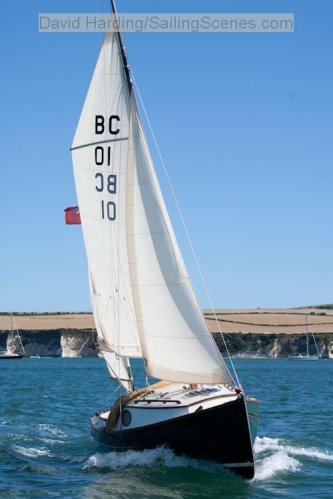
This video of capsize testing of a Bayraider by Denman Marine in Australia, (which they build in Tasmania under licence to Swallowboats) shows just what makes these boats special. The Baycruiser carries 400kg of ballast water and has the additional buoyancy of the cabin with a foam core ceiling. They just don't fall over in the water. If they are pushed over, they just bob up.
31 January 2011
30 January 2011
Sorting out ropes and painting in the cabin
It is really cold, but a sunny day so I've been carrying out some real winter maintenance. I got all the running rigging and washed it in the machine. With a good dollop of fabric conditioner, they come out really soft. I have a problem with the inner core of several braided ropes either sticking out beyond the cover, or poking out of the side between cover strands. I don't know if it is a common problem with braided ropes. Mine are all made by English Braids. In any case, I have recut and resealed the ends with a hot knife. I have replaced the jib halyard with a slightly thinner, longer rope which I think I can yank taughter with a handy billy. I will use the halyard as the main sheet, which I think is a bit too thick for the blocks. I'll see how it works in practice.
After that I started to paint the inside of the cabin. Most of it done except down in the bow and the quarter berth, where I will have to wriggle around head first to reach anything.
29 January 2011
Small jobs, but hard to do much in the cold
I have tidied up the pictures on the bulkhead, which looks a bit more sensible. #What you can't read on this photo is the cabin thermometre, which is reading -3C. It is really cold. Very dry though, which is something. I have carried out a few small jobs, but can't do anything involving paint or glue at these temperatures.
I have fitted a bracket to the outside of the lower washboard. This gives me somewhere to hang the instruments panels when it is raining. If I just have the companionway open, the rain pours in. Fortunately I haven't yet had to to sail in the rain, but it is bound to happen sooner rather than later.
I have cut and shaped two softwood mouldings to fit on the side benches. On the starboard side it will go just on the hinge line of the locker lid. These are meant to stop the flat fenders that I sit on when sailing sliding away under the side deck when tacking. The only problem I have sailing Daisy Grace is that the cabin top is just a bit high to see over easily. But I love the space it gives in the cabin. These strips will need to be epoxied in place, but not at -3. Another job for when it warms up.
I have fitted a bracket to the outside of the lower washboard. This gives me somewhere to hang the instruments panels when it is raining. If I just have the companionway open, the rain pours in. Fortunately I haven't yet had to to sail in the rain, but it is bound to happen sooner rather than later.
I have cut and shaped two softwood mouldings to fit on the side benches. On the starboard side it will go just on the hinge line of the locker lid. These are meant to stop the flat fenders that I sit on when sailing sliding away under the side deck when tacking. The only problem I have sailing Daisy Grace is that the cabin top is just a bit high to see over easily. But I love the space it gives in the cabin. These strips will need to be epoxied in place, but not at -3. Another job for when it warms up.
Nearly there
The roof is slated except for the ridges. The ridge tiles are due on next week. The windows and doors are glazed (but did I really need double glazing?). Gutters and down pipes on. Just the doors to make and hang and then I should be in. But it is freezing cold again. The pond is hard frozen. I suppose it still is January, but I wish it wasn't. The doors will have horizontal boarding in the end. The builder convonced me it will be more weather tight that way as the boards are lapped. I'm going to fit a rain water butt round the back so that I have some water on hand for scrubbing down and washing things with. Other than that, just electricity by way of services.
26 January 2011
Roof slates going on
The slates are going on at last. This view was taken yesterday morning. This whole side has now been completed and they have started on the far slope. The builder is huffing and puffing about how fiddly mitring all of the slates into the valleys is. It is, but it would have looked awful with a flat roof or plain felt.
The whole shed is looking very dominant, partly because it is set up at the top of a slope and partly because the base has had to be built up so high on the house side. When the trees are in leaf it will be largely invisible from this view point. We are going to grow creepers and vines up over this elevation as well, so I think it will all scale down. From the road it looks quite small, which was the intention. That is also why we got planning permission in an AONB without any problems. The local parish council actually supported the application as it tidied up a rough corner and could get some parking off the road, which is always an issue around these lanes.
People often ask how I manage to tow a 20ft boat up to here. The answer is you have to know the way. The direct route is impossible. Only 6ft wide, 1:4 slope and as twisty as a duodenum. The correct route is 2 miles further, only 1:6 and all of 8ft wide. Simple really. The trickiest bit is when you get to us. You can pull the boat straight out of the shed onto the lane, but you can't back it in with the car. You have to park at right angles to the entrance, unhitch the trailer, swing it round 90o and then push it in.
The whole shed is looking very dominant, partly because it is set up at the top of a slope and partly because the base has had to be built up so high on the house side. When the trees are in leaf it will be largely invisible from this view point. We are going to grow creepers and vines up over this elevation as well, so I think it will all scale down. From the road it looks quite small, which was the intention. That is also why we got planning permission in an AONB without any problems. The local parish council actually supported the application as it tidied up a rough corner and could get some parking off the road, which is always an issue around these lanes.
People often ask how I manage to tow a 20ft boat up to here. The answer is you have to know the way. The direct route is impossible. Only 6ft wide, 1:4 slope and as twisty as a duodenum. The correct route is 2 miles further, only 1:6 and all of 8ft wide. Simple really. The trickiest bit is when you get to us. You can pull the boat straight out of the shed onto the lane, but you can't back it in with the car. You have to park at right angles to the entrance, unhitch the trailer, swing it round 90
Subscribe to:
Posts (Atom)